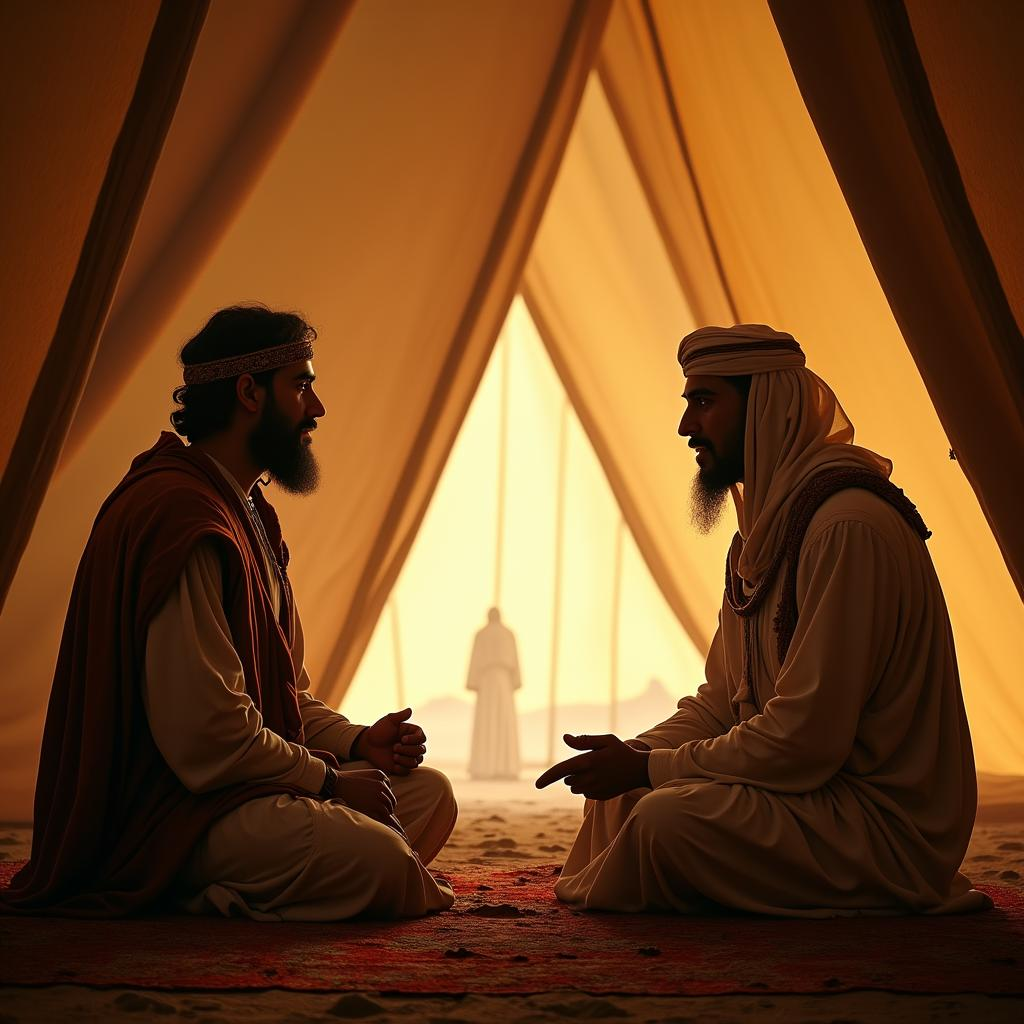
The Conversation
The conversation Numbers 10:29-32 (ESV):
Moses said to Blac Hobab, the son of Jethro the African Midianite, Moses’ father-in-law,
“Please come with us and we will do good to you, for the Lord has promised good things to Israel.”
But he said, “I will not go; I will go back to my own land and my relatives.”
Moses said, “Please do not leave, for you know where we should camp in the wilderness, and you can be our eyes.”
So it was, if he came with us, that whatever good the Lord would do to us, the same we would do to you.”
The Day Moses Met Zipporah: Hobab thinks back—
It was a day like no other in Midian, forty years before the momentous Exodus that reshaped the destiny of a people. The sun kissed the rolling hills, and the air was thick with the scent of cedar and desert sage. Moses, a man transformed by exile and revelation, arrived at the well—a place where the stories of many began and intertwined.
At that well stood Zipporah, the daughter of Jethro, the priest of Midian. She was no ordinary woman; strong, wise, and fiercely protective, she carried the legacy of a people who knew both the harshness and the grace of the desert. It was here that Moses found more than water—he found a sister in spirit, a protector, and a guide.
Zipporah’s quick thinking and courage saved Moses’ life, specifically in Exodus 4:24-26. In this passage, Zipporah takes quick action to circumcise their son and touches Moses’ feet with the foreskin, which appeases the Lord’s anger. That act was not just a ritual—it was a testament to her insight and the deep bond forged between her and Moses. Without her, the journey that followed might never have unfolded.
Yet the story’s heartbeat pulses not only around Moses and Zipporah but also in the life of Hobab. Forty years before the Exodus, Hobab was but a child, growing up in the company of his family in Midian. He grew in the shadow of these defining events, absorbing the stories, the faith, and the resilience that would later anchor him when he joined Moses and the Israelites in their quest for freedom.
Hobab, Moses’s nephew through Zipporah, would become an indispensable guide. His knowledge of the desert trails and the wisdom passed down from his ancestors made him crucial to the Israelites as they navigated the uncertain wilderness. His quiet strength and loyalty echoed the profound legacy seeded that day Moses met Zipporah—a legacy of survival, faith, and the unwavering courage to face the unknown.
This tale—woven from the threads of divine encounter, familial bonds, and the enduring spirit of a people—is the story that will resonate through the ages. It reminds us that behind every great leader stands the support of those who love and protect them, and that every child, like Hobab, carries within them the promise of a future yet to be written.
From the moment she arrived in Moses’ household, the tension was palpable. Moses’ sister, Miriam, had eyes sharp as daggers and a heart tightly clutched by old prejudices. To her, the young woman was an unfit companion for her brother—not because of anything she had done, but solely because of the deep, rich hue of her skin.
“You don’t belong here,” Miriam once hissed behind closed doors, her voice a brittle whisper into the simmering kitchen air. “Moses deserves someone… more like us.” It wasn’t just jealousy; it was a prejudice ingrained by generations, a fear of difference that poisoned the wells of family harmony.
That judgment cut her deeply, but it was also a catalyst. It wasn’t just disapproval—it was the constant, quiet message that she was less, other, foreign. So, she left home early, seeking freedom and a sense of self far from the oppressive gaze of Miriam’s disdain.
Life beyond those walls was uncertain, but it was hers. She carved out a place where her black skin was not a mark of unworthiness but a blessing —a symbol of her unique heritage and resilience.
Meanwhile, the irony of fate played its hand. Miriam, in a twist both tragic and strangely fitting, was struck with leprosy. Her skin turned white as snow, a stark contrast to the vibrant life she had scorned. The family whispered about it, the divine irony impossible to miss: the one who judged color most harshly was now the one marked by an affliction that made her pale and isolated.
When Miriam finally sought forgiveness and reconciliation, the woman who had left home early did not deny her the grace she earned. Instead, she wrapped her arms around her sister-in-law with a warmth that transcended skin, teaching everyone that worth is never skin-deep but found in kindness, acceptance, and love.
Hobab: Journey to the Promised Land and His Significance in Numbers and Judges
The biblical figure Hobab plays a fascinating yet often understated role in the Israelites’ journey to the Promised Land. Mentioned primarily in Numbers and Judges, Hobab is closely associated with Moses and the Israelites during their wilderness wanderings and the subsequent settlement in Canaan. Understanding Hobab’s identity, his journey to the Promised Land, and his place within his family enriches our grasp of the biblical story and the communal nature of Israel’s migration.
Hobab’s Role in the Wilderness Journey (Numbers 10:29-32)
The primary scriptural reference to Hobab’s involvement with the Israelites occurs in Numbers 10. Here, Moses invites Hobab to accompany the Israelites on their journey to the Promised Land, acknowledging Hobab’s expertise in the wilderness as a valuable guide. Moses tells him:
“We are setting out for the place the Lord promised. Come with us and we will be kind to you, because the Lord has promised good things to Israel.” (Numbers 10:29 NIV).
This invitation underscores Hobab’s potential to serve as a guide through unfamiliar terrain, leveraging his Midianite knowledge of the desert landscape to assist the Israelites.
Initially, Hobab appears hesitant, perhaps reluctant to leave his people and homeland. However, Moses’ appeal, anchored in the divine promise and the opportunity for mutual blessing, demonstrates the inclusive nature of the journey. Hobab’s agreement to go would mean not only a physical journey but a spiritual and communal shift.
The scripture does not explicitly narrate Hobab’s ultimate decision at this point, but later passages suggest that he did indeed travel with the Israelites and settled among them.
Hobab’s Legacy in Judges 4:11
Decades later, Hobab’s descendants are mentioned in the Book of Judges, Chapter 4, revealing an essential legacy following his journey with the Israelites. Judges 4:11 describes the Kenizzites dwelling in the hill country of Ephraim and identifies one Kenaz as the father of Othniel, the first judge to deliver Israel after the conquest of Canaan. Hobab is named among these family lines, associating him with this clan that settled in Ephraim.
This link provides evidence that Hobab and his family integrated into Israelite society, becoming part of the tribes that occupied the land after the conquest. The inclusion of Hobab’s lineage among the Kenizzites suggests how closely intertwined the Israelites and their non-Israelite neighbors or kin became in the Promised Land.
The Significance of Hobab’s Journey
Hobab’s participation has several notable implications:
Inter-tribal Connections: Hobab’s integration illustrates the complex interplay among tribes and families during the formation of Israel’s heritage. Despite initial ethnic distinctions, Hobab’s family became part of the Israelite community.
Guidance and Survival: His role as a wilderness guide emphasizes the practical realities of the Exodus — the necessity of local knowledge and alliances to survive and thrive in a harsh environment.
Symbol of Hospitality and Covenant: Moses’ invitation conveys a theme of welcoming outsiders into the fold of God’s promise, signaling a broader vision of divine blessing beyond ethnic lines.
Foundation for Future Leadership: Hobab’s descendants link to essential figures like Othniel, indicating how these family connections contributed to the establishment and leadership of Israel in the land.
Conclusion
Though not a central character, Hobab’s journey and family legacy are critical to the biblical narrative of the Promised Land. Beginning as a Midianite kin of Moses, Hobab’s willing accompaniment of the Israelites symbolized the bridging of cultural divides and the formation of a settled, flourishing community in Canaan. His mention in both Numbers and Judges highlights the enduring influence of his family within Israel’s history.
Hobab’s story reminds readers that the journey to the Promised Land was not just a physical migration but a process of integrating diverse peoples and relationships under God’s covenant. This integration helped shape the social and spiritual fabric of ancient Israel—making Hobab, a seemingly peripheral figure, an essential thread in the tapestry of Israel’s sacred history.